


Help Me Map Out Training for My First Marathon: A 52-Week Roadmap
If you are thinking, “help me map out training for my first marathon,” the safest useful answer is not simply to download a 16-week calendar and start chasing miles. Give yourself enough time to become a consistent runner first, then complete a focused marathon block when your body and daily routine are ready for it.
The framework set out below gradually takes you from the stage of walking or light running to race day in a number of stages, incorporating long runs, easier weeks, strength training, fueling practice, recovery, and clear guidelines for altering the schedule when your life or soreness prevents you from sticking to it.
Quick answer: For the first 36 weeks build up the habit and stamina required to cope with regular running; from week 37 through to week 49 do marathon-specific training and then reduce your training for three weeks. Most of the runs should be easy enough to carry on a conversation and the run-walk method is entirely acceptable.
Key Takeaways
- Choose a race about one year away if you are new to regular running.
- Build consistency before distance. Three manageable runs every week are more valuable than occasional heroic efforts.
- Keep most running easy and add harder work only after you have a reliable base.
- Use a cutback week every three or four weeks instead of increasing mileage continuously.
- Strength train twice weekly during early phases, then maintain one or two short sessions during peak training.
- Practice the same fluids, carbohydrates, shoes, socks, and breakfast you intend to use on race day.
- Treat pain that changes your stride, worsens as you run, or persists at rest as a reason to stop and seek qualified advice.
Before Week 1: Check Whether You Are Ready to Start
It is not necessary for you to be quick, thin, or capable of running at a particular pace, but you do need sufficient time for training, access to safe paths or a treadmill, and a readiness to make the easier days truly easy.
Consult a healthcare professional before beginning if you have chest discomfort with exertion, unexplained fainting or dizziness, unusual breathlessness, a known heart or metabolic condition, or an injury that affects walking. The AHA/ACSM pre-participation screening questionnaire lists symptoms and conditions that warrant medical guidance before increasing exercise.
Pick the Right First Marathon
When choosing a race, look for one that has a generous cutoff time, frequent aid stations, reliable organization, and a course which suits the areas where you train. Generally speaking, a flat or gently rolling route is easier to prepare for than one that includes long climbs, steep descents, high altitude, or unpredictable trail terrain.
Start by counting backwards from race day for a period of 52 weeks and, before paying the fee, check the race’s entry rules, deferral policy, the typical weather conditions, and whether it permits the use of headphones or hydration packs.
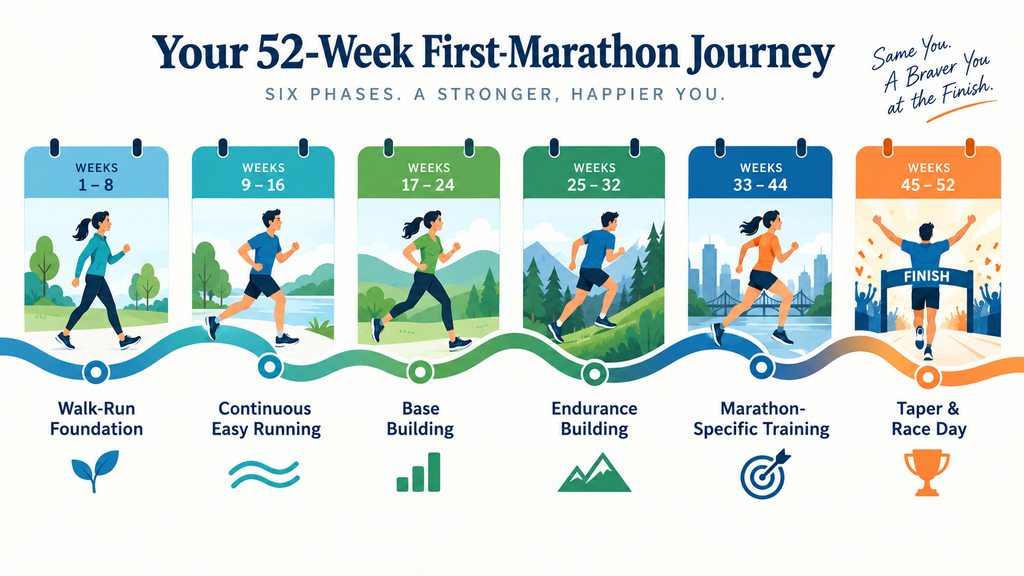
Your 52-Week Marathon Training Schedule at a Glance
This is a framework, not a medical prescription or a pace-specific coaching plan. The long-run ranges assume you are healthy and recovering well; repeat a week or reduce the distance whenever your body or schedule needs more time.
| Weeks | Main goal | Runs per week | Long-run target by phase end | Other priorities |
|---|---|---|---|---|
| 1–4 | Establish the habit | 3 walk-run sessions | 30–40 minutes | Mobility and two strength sessions |
| 5–12 | Run more continuously | 3 | 4–5 miles | Easy effort and good recovery habits |
| 13–20 | Build a durable base | 3–4 | 6–7 miles | Add short relaxed strides |
| 21–28 | Extend endurance | 4 | 8–10 miles | Practice fluids and simple fuel |
| 29–36 | Prepare for marathon training | 4 | 11–13 miles | Optional 10K or half-marathon tune-up |
| 37–41 | Start the specific block | 4 | 14–16 miles | One controlled quality session weekly |
| 42–46 | Develop marathon endurance | 4–5 | 16–18 miles | Fuel every long run and rehearse gear |
| 47–49 | Peak safely | 4–5 | 18–20 miles or a sensible time cap | Final race rehearsal and recovery |
| 50–52 | Taper and race | 3–4, then race | Declining long runs | Reduce volume, keep routine, rest |
The plan does not require a 26.2-mile training run. Your peak run should be long enough to develop confidence and endurance without creating recovery demands that spoil the following week.
Phase 1, Weeks 1–4: Build the Exercise Habit
Start with three nonconsecutive walk-run sessions of 25 to 40 minutes. Alternate comfortable walking with 30 to 90 seconds of gentle jogging, and finish each session knowing you could have done a little more.
A sample first week might use one minute of jogging followed by two minutes of walking, repeated eight times. Adjust the intervals freely because the goal is consistent movement, not proving that you can run without stopping.
Add two short strength sessions using movements such as a chair squat, calf raise, glute bridge, low step-up, wall or incline push-up, and a simple carry or plank variation. General public-health guidance recommends muscle-strengthening activity on at least two days per week, but you can begin with one set and progress gradually; the physical activity guidelines for adults provide the broader health context.
Phase 2, Weeks 5–12: Move Toward Continuous Easy Running
Over time increase the duration of the running sections and decrease the length of the walking sections. By the twelfth week you should be running for a continuous period of 30 to 45 minutes or covering about 4 to 5 miles, taking your planned walk breaks into account.
Use the talk test to control effort. On easy days, you should be able to speak in full sentences; if you can manage only a few words, slow down or walk until your breathing settles.
Every fourth week, reduce the long session and total running time. A cutback is productive training because it gives your muscles, tendons, sleep, and motivation time to catch up with the work already completed.

Phase 3, Weeks 13–20: Build a Base That Can Handle Training
Aim for three or four runs per week, most of which should last between 30 and 50 minutes, while gradually increasing the length of the long run to 6 or 7 miles. However, if four runs leave you feeling persistently tired, then stick to three and use low-impact cycling, swimming, or walking as optional aerobic exercises.
Once easy running feels stable, add four to six relaxed strides after one easy run. Each stride is a smooth 15- to 20-second acceleration with full walking recovery, not an all-out sprint.
If you are to carry on with strength training twice a week then make sure that you are able to recover. Since the best routine is the one that you can carry out repeatedly, focus on basic exercises for the calves, hips, hamstrings, quads, trunk and upper body rather than on exhausting circuits.
Phase 4, Weeks 21–28: Extend Your Endurance
When increasing the distance from about 7 to 9 or 10 miles, carry on at a conversational pace. It is not advisable to add more distance, speed, hills, and include an extra running day in the same week; it is easier to determine what your body can tolerate if you change only one major stressor at a time.
The popular “10% rule” is not a guarantee against injury and does not fit every runner. Research on sudden training-load changes and running injuries is mixed, so treat gradual progression as a sensible principle rather than a magic percentage; a systematic review of training-load changes found the evidence too limited for a universal rule.
Begin carrying fluid when route conditions or run duration require it, and test small amounts of carbohydrate on runs longer than an hour. Note the product, amount, timing, weather, and stomach response in your training log.

Phase 5, Weeks 29–36: Get Ready for the Marathon Block
Your goal is to arrive at week 37 comfortable with four weekly runs and a long run of roughly 11 to 13 miles. This phase is the bridge between general fitness and the sustained workload of marathon preparation.
You can include one controlled training session per week, for example 20 minutes at a comfortably hard intensity or six brief hill repeats followed by complete easy recovery. As before, keep the day before and the day after easy and omit the intense session when fatigue, illness, heat, or soreness is particularly high.
An organized 10K or half marathon can serve as a rehearsal, but race it only if it fits your recovery needs. Practice waking up, eating breakfast, dressing for the weather, reaching the start on time, and beginning more slowly than excitement tells you to.
Phase 6, Weeks 37–49: Complete the Marathon-Specific Block
This is where the long runs become more specific, but most weekly running should still be easy. A typical week includes one long run, two or three easy runs, one controlled quality session, one or two short strength sessions, and at least one complete rest day.
A Practical 13-Week Long-Run Sequence
| Week | Suggested long run | Focus |
|---|---|---|
| 37 | 12 miles | Settle into the new block |
| 38 | 14 miles | Fuel and hydrate early |
| 39 | 10 miles | Cutback and absorb training |
| 40 | 15 miles | Keep the opening miles slow |
| 41 | 16 miles | Rehearse shoes and clothing |
| 42 | 12 miles | Cutback week |
| 43 | 16 miles | Practice race breakfast |
| 44 | 17 miles | Stay conversational |
| 45 | 13 miles | Cutback week |
| 46 | 18 miles | Full fueling rehearsal |
| 47 | 14–15 miles | Recover while maintaining rhythm |
| 48 | 18–20 miles or time-capped equivalent | Peak race rehearsal |
| 49 | 14–16 miles | Begin reducing load |
These are suggested distances, not tests you must pass. Slower first-time runners may be better served by capping the longest outing around three to three and a half hours, while others may complete 18 to 20 miles within a manageable duration; individualize this choice with a qualified coach if possible.
Do not squeeze a missed peak run into the next week. Resume the plan at a manageable point because one skipped run costs less fitness than an injury caused by trying to repay “training debt.”
Example Marathon-Training Week
| Day | Session |
|---|---|
| Monday | Rest or gentle mobility |
| Tuesday | Easy run plus 4–6 relaxed strides |
| Wednesday | Short strength session or low-impact cross-training |
| Thursday | Controlled tempo, steady hills, or easy run |
| Friday | Rest |
| Saturday | Short easy run |
| Sunday | Long easy run with fueling practice |
Move the days to fit your life, but avoid stacking a demanding workout immediately before the long run. If work, caregiving, poor sleep, or hot weather raises the stress outside training, reduce the training stress inside the plan.

How Hard Should Each Run Feel?
When running your first marathon, putting in genuine effort is more reliable than copying the pace of another runner. The conditions such as weather, the presence of hills, the amount of sleep, stress, and accumulated fatigue can all affect how much a particular pace costs your body.
| Session | Effort cue | Purpose |
|---|---|---|
| Easy or recovery run | Full-sentence conversation | Aerobic fitness with manageable fatigue |
| Long run | Calm and controlled, especially early | Endurance, fueling, and time on feet |
| Steady or marathon-effort segment | Short sentences, never desperate | Pacing control and specific endurance |
| Tempo effort | A few words at a time, controlled | Higher-end aerobic development |
| Strides | Fast but relaxed for seconds, full recovery | Coordination and leg turnover |
It is not necessary to include intervals, tempo runs, and marathon-pace workouts every week; if your primary aim is to finish the race comfortably, then consistency and allowing adequate recovery after your long runs are more important than filling your weekly schedule with advanced types of training.
Fueling and Hydration: Practice Before Race Day
Start long runs well fed instead of using them as weight-loss sessions. For runs lasting longer than about an hour, sports-nutrition guidance commonly recommends carbohydrate during exercise; a research review explains the widely used range of 30 to 60 grams of carbohydrate per hour for endurance exercise, though your stomach may need time to adapt.
Start off at the lower end and try standard choices like gels, chews, sports drink or easy-to-carry foods. Add up the carbohydrate content from both the food and the drink, and if the instructions for any product say to take it with water then do so, never introducing a new high dose on the day of the race.
The amount of fluid needed varies depending on your body size, the speed at which you’re travelling, the temperature, the humidity, the rate at which you sweat, and whether or not you have access to aid stations. Do not intentionally drink too little fluid nor push yourself to consume excessive amounts; instead, follow a sensible individual plan for fluid intake and consult a sports dietitian if you have a medical condition, lose a lot of salt, or suffer from recurrent stomach troubles.

Shoes, Clothing, and Race-Day Rehearsal
Choose shoes that feel comfortable during running rather than buying by appearance or assuming the most expensive model is safest. Rotate a second pair only if it suits your budget and both pairs feel good; do not make major footwear changes during peak weeks.
Use long runs to test socks, anti-chafe products, weather layers, pockets, watch settings, and bathroom timing. Your final peak long run should resemble race morning closely enough to expose practical problems while there is still time to solve them.
Skin comfort matters during months of outdoor training, particularly when weather changes or sweat and friction increase. StoryPrior’s wellness and recovery guides can support the broader self-care side of your routine, while running pain or recurring physical symptoms should be assessed by an appropriate healthcare professional.
Weeks 50–52: Taper Without Panicking
The taper reduces accumulated fatigue while preserving the fitness you already built. Cut weekly volume progressively, keep a little familiar intensity in shorter sessions, and resist the urge to prove your fitness with one last long or fast workout.
Evidence from recreational marathon data suggests that a disciplined taper is associated with better performance, with longer, progressive tapers outperforming short or inconsistent ones. A simple three-week approach is to reduce the long run and overall mileage each week while retaining the usual number of running days until race week, when rest becomes the priority.
Take the extra time to sleep, work on arranging your travel plans, go over the course, clip your toenails a few days before the event, and sort out your usual gear. It is possible to experience a slight sluggishness or nervousness during the tapering period and this should not be a reason to include more training.

Race-Day Plan for a First Marathon
Eat the breakfast you rehearsed, arrive early enough to avoid rushing, and start more slowly than your emotions suggest. Crowds and fresh legs can make the first miles feel unusually easy, but spending energy early often makes the final third much harder.
Follow the fueling and hydration routine you practiced, adjusting sensibly for weather and aid-station spacing. Planned walk breaks from the beginning can be more effective than waiting until exhaustion forces you to walk.
Set yourself three objectives: an A objective for having an excellent day, a B objective which would leave you satisfied, and a C objective focused on completing the event safely. If you experience chest pain, dizziness, confusion, severe shortness of breath, or any other alarming symptoms, stop and get medical assistance rather than trying to keep your finish time.
How to Adjust the Plan When Training Goes Wrong
Omitting a few days doesn’t cancel out months of previous preparation. If the interruption has been short, return by running easily and then check how you are feeling; but if the illness, injury, or absence has been longer or has lasted for several weeks, revert to a previous level rather than immediately going back to your old routine.
Use these simple decisions:
- Normal tiredness: Keep the next session easy or take an extra rest day.
- Persistent heavy legs or declining performance: Reduce the week’s volume and remove intensity.
- Pain that changes your stride or worsens during the run: Stop running and obtain qualified assessment.
- Fever, chest symptoms, vomiting, or significant illness: Do not train through it; resume only when medically appropriate.
- Repeated stomach trouble: Simplify the pre-run meal, lower the carbohydrate dose temporarily, and rebuild tolerance gradually.
The plan should bend before your body breaks. Finishing slightly undertrained but healthy is usually a better position than arriving exhausted after completing every workout on paper.
Common First-Marathon Training Mistakes
- Running easy days too fast, which makes recovery and long runs harder.
- Increasing long-run distance while also adding speed and another running day.
- Skipping strength work early, then starting a demanding gym routine during peak weeks.
- Treating every long run as a race or pace test.
- Waiting until race day to test breakfast, gels, hydration, shoes, or clothing.
- Trying to make up missed sessions by cramming them together.
- Ignoring pain because the calendar says a workout is important.
- Copying the weekly mileage of a faster or more experienced runner.
Frequently Asked Questions
How long should a beginner train for a first marathon?
Many established runners use a focused 16- to 20-week marathon plan, but a true beginner often benefits from six to twelve months overall. The extra time builds the basic running habit and endurance needed to tolerate the specific plan rather than stretching marathon-level training across an entire year.
What is a 52 week marathon training schedule?
A 52 week marathon training schedule is a year-long progression that begins with general fitness and ends with race-specific preparation. It should contain distinct phases, recovery weeks, a peak period, and a taper instead of increasing mileage every week for a year.
Can I train for a marathon if I cannot run a mile yet?
Yes, if you allow enough time and have no medical reason to avoid the activity. Begin with walking and short jogging intervals, progress by effort rather than ego, and postpone the race if you cannot build consistently without recurring pain or excessive fatigue.
Why is a marathon 42.2 km?
The official distance is 42.195 km, or 26 miles 385 yards. The unusual length traces to the 1908 Olympic marathon route in London and was later adopted as the standard, which is why people commonly round it to 42.2 km.
Is it true only 1% of people run a marathon?
The “1%” statement is a popular estimate, not a precisely verified global statistic. Worldwide participation records count finishes rather than unique lifetime finishers, so it is safer to say marathon completion is uncommon without presenting 1% as an exact fact.
What should my longest run be before my first marathon?
Many beginner plans peak around 18 to 20 miles, but time on feet, pace, recovery history, and weekly mileage all matter. A slower runner may use a sensible time cap rather than staying out so long that the recovery cost outweighs the benefit.
Can I use walking breaks in a marathon?
Yes. Planned run-walk intervals can help a first-timer control effort, take fuel, and manage fatigue, especially when practiced from the beginning of long runs rather than saved as an emergency response.
Conclusion
When you say, “help me map out training for my first marathon,” the real goal is not to fill 52 boxes with ever-longer runs. It is to build a stable habit, develop endurance in phases, practice race-day details, recover from the work, and reach the start line healthy enough to enjoy what you prepared for.
Choose your race, count back 52 weeks, and schedule only the first four weeks today. Once those weeks feel repeatable, continue through the next phase and adjust the roadmap to your recovery, health, and life rather than forcing your life to obey a perfect calendar.