


1 ml Cheek Filler Before and After: What Changes?
If you are comparing 1 ml cheek filler before and after photos, expect refinement rather than a guaranteed transformation. One milliliter can add mild cheekbone definition, replace a small amount of midface volume, or improve modest asymmetry, but the result depends on your anatomy, the product, the injection plane, and whether that 1 mL is shared between both cheeks.
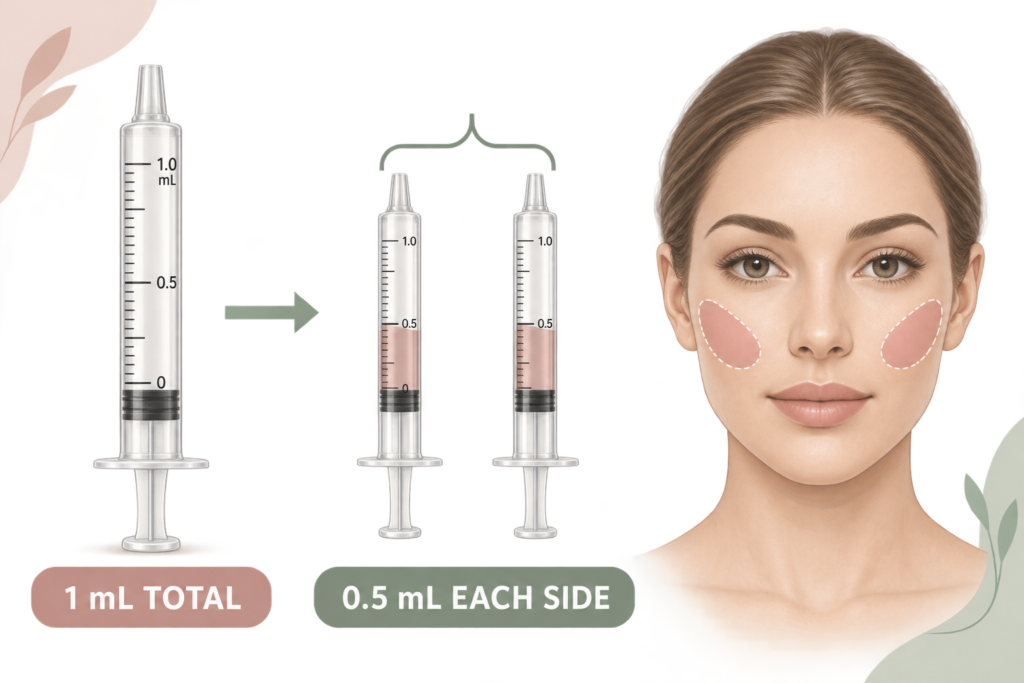
The most important detail is often missing from social posts: “1 mL in the cheeks” may mean 1 mL total, or 0.5 mL on each side. That is very different from 1 mL per cheek, which uses 2 mL total. A qualified medical injector should recommend a plan based on your face and goal, not force every person into the same volume.
Medical note: This article offers general education, not individual medical advice. Dermal filler is a medical procedure with rare but potentially serious complications, so discuss your health history, options, and risks with a properly licensed and appropriately trained healthcare professional.
Quick Answer: Does 1 mL of Cheek Filler Make a Difference?
Yes, 1 mL of cheek filler can make a visible difference, especially in a smaller face, mild volume loss, modest asymmetry, or a first treatment aimed at subtle contour. However, 1 mL total may create only a slight change when divided between two cheeks, and it may not adequately correct marked hollowing or age-related volume loss.
You may notice a little more projection from a three-quarter view, a smoother transition through the midface, or slightly clearer cheekbone definition. Results are usually visible immediately, but early swelling can exaggerate or blur the change, so the first-day appearance should not be treated as the final result.
Key Takeaways
- One millilitre total commonly produces a subtle result when shared between both cheeks.
- “1 mL total” and “1 mL per cheek” are not the same treatment plan.
- Anatomy, filler properties, placement, and injector technique matter as much as volume.
- Immediate photos can be misleading because swelling and redness have not settled.
- Standardized photos taken after recovery give a fairer before-and-after comparison.
- Bruising, swelling, tenderness, and redness can occur; severe pain or vision changes require urgent medical attention.
- Choose a licensed healthcare professional who can explain the product, risks, alternatives, and emergency plan.
What Can 1 mL Actually Change?
Cheek filler is used to add or restore volume in the midface. The FDA lists increasing fullness in the cheeks among approved uses for certain dermal fillers in adults aged 22 and older, but approval applies to particular products, indications, and instructions rather than every filler in every location.
With an appropriate product and plan, 1 mL may create one or more of these modest effects:
- A slightly more defined upper or lateral cheek contour
- Mild restoration of flattened or early volume loss
- A small improvement in left-to-right balance
- A smoother visual transition between the lower eyelid and cheek in selected patients
- Subtle structural support that changes how light falls across the midface
It cannot guarantee a lift, erase deep folds, correct substantial laxity, or reproduce another person’s face. Filler adds volume; it does not tighten skin in the same way as surgery, and more filler is not automatically the right answer for loose skin or complex under-eye concerns.
Why the Same 1 mL Looks Different on Every Face
A narrow face with mild flattening may show a clearer change from 1 mL than a broader face with substantial volume loss. Bone structure, fat distribution, skin thickness, age-related changes, facial movement, baseline asymmetry, and the desired result all affect how noticeable the outcome appears.
The gel itself also matters. Hyaluronic acid fillers differ in firmness, flexibility, cohesivity, and approved indications, so equal volumes of two products may not behave or look identical. Placement deep near bone can serve a different purpose from more superficial placement, which is why comparing volume alone leaves out much of the clinical decision.
How to Judge Before-and-After Photos Honestly
Good before-and-after photography should show the same person, expression, lens, distance, angle, posture, and lighting. A front view alone can hide changes in projection, so front, oblique, and profile views are more useful together.
Look for the date of the “after” image. Photos taken immediately after injection may include swelling, redness, and temporary asymmetry, while makeup, contouring, smiling, head tilt, or a closer camera can make the result seem larger than it is. The most trustworthy galleries state the total volume, whether it was divided between the cheeks, the product used, and the time between treatment and photography.
Use this checklist when reviewing a gallery:
- Confirm that both images use the same angle and facial expression.
- Check whether the lighting creates artificial shadow or cheek definition.
- Look for the total amount used across the entire treatment area.
- Find out whether other areas, such as the chin, jawline, or under-eyes, were treated.
- Prefer settled images over immediate post-injection images.
- Remember that another patient’s result cannot predict yours.

0.5 mL vs 1 mL vs 2 mL vs 3 mL Cheek Filler
These numbers describe volume, not a universal recipe. A safe and effective amount cannot be chosen from a chart alone, and treatment may be staged rather than completed in one visit.
| Total volume discussed | What it may mean | Possible visual goal | Important limitation |
|---|---|---|---|
| 0.5 mL total | A very small amount, possibly focused on one feature or divided between sides | Minimal refinement or a tiny asymmetry adjustment | May be difficult to see across both cheeks |
| 1 mL total | Often 0.5 mL per cheek if divided evenly | Subtle definition or mild volume restoration | May be insufficient for broader faces or greater volume loss |
| 2 mL total | Often 1 mL per cheek, though allocation can be unequal | More visible bilateral support or contour | Still must be individualized; “more visible” does not mean better |
| 3 mL total | May be distributed across several midface points or staged | Broader correction in selected patients | Greater volume increases cost and does not replace careful diagnosis |
A clinician may deliberately use unequal amounts when natural asymmetry is present. Equally splitting a syringe is not always the most balanced approach, because the two sides of a face are rarely identical.
1 mL vs 2 mL Cheek Filler
The practical difference is simple: 2 mL is twice the volume, but it will not necessarily look twice as dramatic. Product choice and placement influence how that volume translates into shape and projection.
If 1 mL total is divided into 0.5 mL per side, it often suits a conservative first step. Two millilitres total may give the injector more scope to treat both cheeks, yet a responsible consultation may still favor staged treatment to limit overcorrection and reassess the face after swelling resolves.
What About 3 mL Cheek Filler Before and After?
Three millilitres may be considered when a person needs more extensive midface support, but the number alone says little about suitability. Ask whether all 3 mL will be placed in the cheeks, spread across nearby areas, or divided between appointments.
Large changes may also indicate that something other than filler should be discussed. If the main issue is significant skin laxity, bags beneath the eyes, or a desire for a surgical-level lift, adding more gel may not address the underlying concern.

Cheek Filler Results Timeline
Dermal filler often changes contour immediately, but “immediate” does not mean “settled.” The Cleveland Clinic’s medically reviewed filler guide notes that bruising, swelling, or discomfort can occur and that many people see results right away, with outcomes varying by the treatment received.
| Time | What you may notice |
|---|---|
| Immediately after | Added volume plus possible redness, tenderness, swelling, or unevenness |
| First few days | Swelling or bruising may become more noticeable before improving |
| Around 1–2 weeks | A more useful time to assess symmetry and contour as early effects settle |
| Follow-up | Your provider reviews healing and decides whether observation, adjustment, or no further treatment is appropriate |
| Following months | The result gradually changes as the temporary filler breaks down |
Your clinician’s instructions and review schedule should take priority over a generic timeline. If you also start several new products around the same time, it becomes harder to identify the cause of irritation; the same principle of changing one variable thoughtfully appears in StoryPrior’s guide to how long skincare products take to work.
How Long Does 1 mL of Cheek Filler Last?
There is no single duration for all cheek fillers. The Cleveland Clinic explains that filler results may last months or years depending on the material and location, while hyaluronic acid filler results commonly last for a limited period and gradually diminish.
Longevity also depends on the specific product, how and where it is placed, your biology, and how the outcome is measured. Treat any clinic promise of an exact expiration date cautiously, and ask what evidence supports the expected duration for the named product in the intended cheek area.

Cheek Filler Cost: What Are You Paying For?
Cheek filler cost varies by geographic area, provider experience, product, number of syringes, and whether follow-up care is included. Elective cosmetic filler is generally not covered by health insurance, so ask for the complete expected price before treatment rather than comparing a promotional per-syringe number alone.
A useful written quote should clarify:
- The exact product and total volume proposed
- Whether the price is per syringe or for the complete treatment
- Whether both cheeks are included
- Consultation and follow-up fees
- The policy for unopened or unused product
- Charges for managing non-emergency adjustments or dissolving hyaluronic acid filler
- Who provides urgent care if a complication occurs
The cheapest offer may exclude follow-up or come from someone without suitable medical training. Experience, anatomy knowledge, authentic product handling, sterile technique, informed consent, and a complication plan are meaningful parts of the service.
Risks and Side Effects You Should Understand
Common reactions include bruising, redness, swelling, pain, tenderness, itching, and rash. The FDA states that many filler side effects appear shortly after injection and resolve within days to weeks, although delayed reactions can occur.
Rare complications can be severe. Accidental injection into a blood vessel can cause tissue death, stroke, or blindness, and a published review of vision loss associated with hyaluronic acid fillers found that onset was nearly always immediate in the cases reviewed. Another review of delayed reactions to 15 hyaluronic acid fillers found that reaction rates differed by product and that the cause of delayed reactions remains disputed.
Get Urgent Help for These Warning Signs
Follow the emergency instructions given by your treating clinician. Seek immediate medical help for symptoms such as:
- Sudden or worsening severe pain
- Blanching, dusky discoloration, or a net-like color change in the skin
- New vision changes, eye pain, drooping, or loss of vision
- Weakness, difficulty speaking, or other stroke-like symptoms
- Rapidly worsening swelling or signs of a severe allergic reaction
Do not wait for a social-media reply or routine follow-up if a serious symptom appears. The FDA advises using a licensed healthcare provider experienced in dermatology or plastic surgery and trained to inject fillers, and it warns against self-injection, products sold directly to consumers, and needle-free filler pens.

How to Choose a Safer, Qualified Provider
Licensing rules and who may legally inject vary by jurisdiction, so verify the person’s current professional license and relevant training. If you choose a plastic surgeon, the American Board of Plastic Surgery explains how certification can be verified; dermatology patients can likewise verify appropriate specialty credentials through the relevant recognized board.
Ask these questions during the consultation:
- What is your professional license, specialty training, and experience injecting the midface?
- Which exact product do you recommend, and is it approved for this use?
- Does “1 mL” mean total volume or 1 mL per cheek?
- Where will you place it, and what visual goal is each placement meant to address?
- What are the alternatives, including doing nothing or staging treatment?
- What complications can occur, and what is your same-day emergency process?
- Do you stock the supplies and medication needed to manage vascular occlusion when using hyaluronic acid filler?
- May I see consistent, settled photos of your own patients with similar anatomy?
Tell the clinician about allergies, medical conditions, previous fillers, dental work, infections, pregnancy or breastfeeding, and every prescription, supplement, and over-the-counter medicine you use. Do not stop prescribed medication on your own just to reduce bruising; ask the prescriber and injector what is medically appropriate.

Preparing for Treatment and Comparing Your Own Results
Arrive with clean skin if your clinic requests it and follow its pre-treatment instructions. Avoid scheduling immediately before an important event because bruising or swelling may occur, and do not copy online advice to stop prescription drugs or take unproven supplements.
Take baseline photos in indirect daylight with no beauty filter, neutral expression, and consistent front, three-quarter, and profile views. Repeat them after the settling period recommended by your clinician; choosing a simple routine for acne-prone skin may also be helpful if you need to avoid introducing multiple irritating products while monitoring your skin.
After treatment, follow the personalized instructions you receive rather than pressing, massaging, or attempting to reshape the filler unless specifically told to do so. Contact the treating clinic about unexpected symptoms, and use emergency care for the urgent warning signs described above.
Frequently Asked Questions
Does 1 mL of cheek filler make a difference?
It can, particularly for subtle contour, mild flattening, or a small asymmetry. The difference may be modest when 1 mL is split into 0.5 mL per cheek, and your anatomy, product, and placement can matter as much as the amount.
Is one syringe of cheek filler the same as 1 mL?
Many dermal-filler syringes contain about 1 mL, but you should not assume that every package has the same volume. Ask to see the sealed product label and confirm the syringe volume, product name, lot information, and how much will be used.
Is 1 mL of cheek filler enough for both cheeks?
It may be enough for a conservative change if it is divided between both cheeks. It may not meet the goal when volume loss is greater, the face is broader, or more than one midface concern needs treatment, so the decision should follow an in-person assessment.
Is 1 mL per cheek too much?
One millilitre per cheek means 2 mL total, and whether that is appropriate depends on anatomy, product, placement, and the intended result. A number cannot be labelled “too much” or “just right” without examining the face, but you can ask about a staged approach if you prefer a conservative change.
When should I take my 1 ml cheek filler before and after photo?
Take the “before” image prior to treatment under standardized conditions, then repeat it after the settling period advised by your injector. Immediate photos document the procedure-day change but can overstate or obscure the final result because of swelling and redness.
How long does cheek filler swelling last?
Swelling commonly appears soon after treatment and often improves over the following days, but the course varies. Contact your provider if it is severe, worsening, unusually painful, accompanied by skin color or vision changes, or otherwise different from the recovery pattern they described.
Can cheek filler be dissolved if I dislike it?
Some hyaluronic acid fillers can be reduced with hyaluronidase, but dissolving is another medical procedure with its own limitations and risks. Other filler materials may be difficult or impossible to remove, so confirm the exact product and reversal options before treatment.
Conclusion
A realistic 1 ml cheek filler before and after result is usually a subtle shift in contour or volume, not a guaranteed facial transformation. The most useful comparison states whether the amount was 1 mL total or per cheek, shows settled photographs under matching conditions, and explains what else was treated.
If you are considering cheek filler, book a consultation with a properly licensed and suitably trained healthcare professional. Bring reference photos as a communication tool, ask for the exact product and total-volume plan in writing, review risks and alternatives, and choose safety and natural facial balance over chasing a syringe number.