


How Long Does It Take for Skin Care to Work?
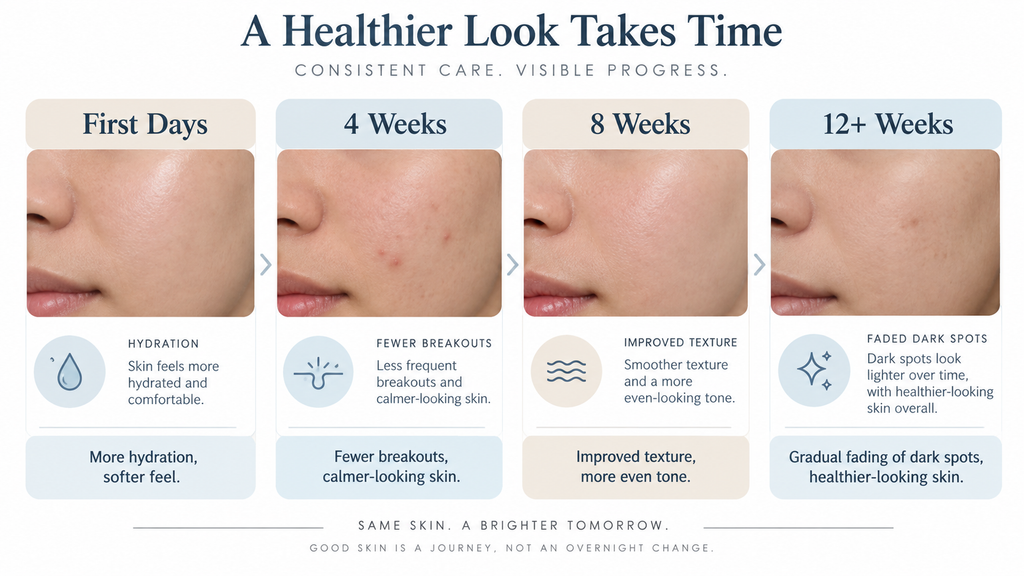
You start a new cleanser, moisturizer, acne treatment, or serum and naturally want to know when you should see a difference. So, how long does it take for skin care to work? For many products, noticeable improvement takes roughly four to twelve weeks, but there is no single timeline that applies to every product or skin concern.
Some effects are much faster. A moisturizer can make dry skin feel more comfortable almost right away and might make dehydration lines appear softer after a few days; on the other hand, acne treatments usually take several weeks and significant improvements in uneven skin tone, texture, fine lines, and other more long-term issues can take two or three months or longer.
What matters is having a clear idea of the result you want and then evaluating the product against the right timeline.
Quick Answer: How Long Does It Take for Skin Care to Work?
A general rule that is helpful is to use most skincare products which are focused on treating your skin for at least six weeks before judging whether or not they are effective, on the condition that they are not causing your skin to become irritated. The American Academy of Dermatology points out that most anti-aging products take at least six weeks to show results and may in some cases need as long as three months.
Here is a practical overview:
| Skincare goal or product | When you may notice a change |
|---|---|
| Cleanser | Immediately for cleansing |
| Moisturizer | Immediately to several days |
| Hydrating products | Hours to several days |
| Acne treatment | About 4–8 weeks for noticeable improvement |
| Niacinamide | Often 4–12 weeks depending on the goal |
| Retinoids for acne | Usually several weeks |
| Retinoids for texture/fine lines | Often 2–3+ months |
| Dark-spot treatments | Usually several weeks to several months |
| Sunscreen | Protective benefit starts with correct daily use; apply before sun exposure |
| Full skincare routine | Usually 6–12 weeks to judge meaningful overall progress |
They don’t constitute guarantees; the timeline can vary depending on factors such as the formula, concentration, frequency of use, the condition being treated, your skin type, any irritation, the medications you are taking, your level of sun exposure, and how consistently you use the product.
Why Skincare Results Take Time
Not all skincare products carry out the same function. A moisturizer primarily alters the water content of the skin and the way the outer surface of your skin feels, which is why you can see the effects of it fairly quickly. On the other hand, a treatment intended for reducing recurrent acne, improving pigmentation, or affecting the signs of photoaging relies on biological processes that take longer to develop.
Which is why it is not very useful to check your face every morning if you want to assess your progress, since small changes are difficult to notice from one day to the next.
It is also why constantly replacing products can work against you. If you introduce a new routine every two weeks, you may never give a well-tolerated product enough time to demonstrate whether it actually helps.
How Long Different Skin Care Products Take to Work
Cleanser: You Should Notice Its Basic Effect Immediately
The main function of a cleanser is to remove from the skin sweat, oil, sunscreen, makeup, and other substances, so you will generally be able to tell quite soon whether or not it cleans your face comfortably.
You should not expect a regular cleanser to remove pigmentation, wrinkles, or stubborn acne after just a few washes, since even those containing active ingredients have only a relatively short time of contact with the skin.
After beginning to use a cleanser, a more appropriate question to ask is whether your skin seems clean without it becoming painfully tight, burning, extremely dry, or irritated.
Moisturizer: Immediate Comfort, Longer-Term Barrier Support
Moisturizer is one of the fastest skincare products to judge. Dryness and tightness may feel better after application, while the temporary plumping caused by additional moisture can make some fine dehydration lines less noticeable.
The American Academy of Dermatology specifically notes that moisturizer can plump fine lines within a few days.
That does not mean moisturizer permanently removes wrinkles. Its fastest visible effects come primarily from improving hydration at the skin’s surface.

Acne Treatments: Expect Weeks, Not Days
It is in this case that people generally give up too soon. Although acne treatments can sometimes make individual inflamed pimples less noticeable rather quickly, stopping breakouts from recurring demands more patience.
The American Academy of Dermatology suggests that an acne treatment should be given at least four weeks’ time; if it works, some improvement might be seen within four to six weeks while more significant clearing could take as long as two to three months or even longer.
AAD guidance elsewhere notes that people undergoing acne treatment may need at least six to eight weeks before they begin seeing fewer breakouts.
That means a reasonable evaluation should look at the overall pattern:
- Are you developing fewer new pimples?
- Are breakouts becoming less severe?
- Is inflammation decreasing?
- Are old lesions clearing without being replaced as quickly?
Severe, painful, cystic, scarring, or persistent acne is different. In those situations, experimenting indefinitely with cosmetic products can delay appropriate treatment, and a dermatologist can help determine whether prescription therapy is needed.
Retinol and Other Retinoids: Several Weeks to Months
Retinoids are commonly used to treat acne, uneven texture, pigmentation problems, and the signs of ageing. They affect biological processes rather than merely altering how your skin feels, which is why patience is necessary.
Topical retinoids are usually evaluated in clinical studies of acne over a period of about 12 weeks, and systematic reviews have shown that they are effective in treating both inflammatory and non-inflammatory acne.
When it comes to cosmetic issues like texture and fine lines, you should consider the time frame in terms of months rather than expecting significant results after just one week. The American Academy of Dermatology recommends that most anti-aging products be used for at least six weeks, and in some cases as long as three months, before assessing them.
More is not necessarily better. Retinoids can cause dryness, peeling, redness, and irritation, especially when introduced too aggressively. AAD guidance recommends measures such as adjusting frequency or using moisturizer when appropriate.
Niacinamide: Around a Month for Some Changes, Longer for Others
Niacinamide is included in a number of products which are designed to correct uneven skin tone, redness, oiliness, texture, and signs of ageing. The speed at which it acts will vary depending on both the formulation and on the particular condition you are trying to improve.
In a controlled study, topical niacinamide was found to significantly reduce hyperpigmentation after four weeks; in another clinical study which lasted 12 weeks, improvements were reported in a number of aspects of the appearance of facial skin, such as hyperpigmented spots, fine lines, texture, and blotchiness.
This is a good example of why skincare timelines should be viewed as ranges. One change can appear earlier while other benefits from the same ingredient continue developing over several months.

Dark Spots and Uneven Skin Tone: Be Prepared to Wait
Pigmentation tends to be slower and more complicated than simple hydration. The cause matters, too. Post-acne marks, sun-related pigmentation, melasma, irritation-related pigmentation, and other discoloration should not automatically be treated as the same problem.
Studies commonly track participants for a period of 8 to 12 weeks or even longer when looking at the ingredients used for pigmentation. For instance, clinical research into the use of azelaic acid for acne-related post-inflammatory hyperpigmentation has employed 12-week treatment periods.
Sun protection is especially important if you are attempting to deal with uneven pigmentation, since continued exposure to ultraviolet radiation can counteract the rest of your skincare routine.
Sunscreen: Think Prevention Rather Than “Visible Results”
Unlike most of the products discussed in this article, sunscreen has the main role of preventing ultraviolet damage rather than producing a cosmetic transformation over night.
The FDA recommends that sunscreen be applied about 15 minutes before sun exposure and that it be reapplied at least every two hours, especially after swimming or sweating.
The American Academy of Dermatology suggests the use of a broad-spectrum, water-resistant sunscreen with a sun protection factor of 30 or above and also recommends that it be applied about 15 minutes before going outside.
You may never look in the mirror and see the damage that sunscreen successfully prevented. That does not mean it is not working.
How Long Does It Take for Skincare to Absorb?
This question is a bit different from asking when skincare shows results.
A product doesn’t have to become fully invisible before you can carry out each of the following steps. The American Academy of Dermatology places greater emphasis on the correct order of products than on strict waiting periods; you should cleanse first, then apply the medication or treatments, followed by moisturizer and/or sunscreen, and finally by makeup if you wish to do so.
It is useful when using products every day to let them settle before applying the next one, especially if the products are moving around, pilling, or mixing poorly. There’s usually no need to stand in the bathroom with a stopwatch between each serum and moisturizer.
Sunscreen deserves more attention. Apply it after your other skincare products, allow it to form an even layer, and follow label instructions about application before sun exposure.

How Do I Know If My Skincare Routine Is Working?
You shouldn’t evaluate success solely on the basis of your skin suddenly appearing flawless; instead, you should look for changes that correspond with the very reason that originally led you to start using the product.
For a moisturizer that you’ve begun because your skin was dry, success would be measured by a reduction in tightness and flaking. And with regard to an acne treatment, it’s more significant that fewer new breakouts occur over a number of weeks than it is that one pimple vanishes overnight.
A good method of monitoring progress is to take a clear photograph before you begin a treatment and then take another one every four weeks in about the same position and lighting. You should not change ten products at the same time since in that case you would have no reliable way of knowing which product had helped or had caused a problem.
Why Your Skincare May Not Seem to Be Working
Sometimes the problem is not patience. A product may simply be unsuitable for your concern, skin type, or routine.
Common reasons include:
- You are switching products too quickly. A treatment that normally needs six to eight weeks cannot be evaluated fairly after ten days.
- You are using too many active products. Irritation can cause redness, dryness, burning, breakouts, and sometimes worsening pigmentation.
- You are inconsistent. A treatment used once every few weeks will not perform like the same treatment used according to its directions.
- You are targeting the wrong problem. What looks like ordinary acne, dryness, redness, or pigmentation may sometimes have a different underlying cause.
- You are ignoring sun protection. UV exposure can contribute to premature skin aging and make some pigmentation problems harder to manage.
- Your expectations are unrealistic. Cosmetics cannot reproduce filtered photos or permanently erase every pore, line, or natural variation in skin texture.

When Should You Stop a New Skincare Product?
Waiting patiently does not mean continuing through every negative reaction.
Stop using a non-prescription cosmetic product and reassess if you develop significant swelling, hives, blistering, persistent burning, severe redness, or another concerning reaction. Seek medical care when symptoms are serious or do not settle.
Mild dryness can occur with certain active ingredients, particularly retinoids and acne treatments, but you should not assume that intense pain or worsening inflammation is proof that a treatment is “working.”
If you have persistent acne, rosacea-like redness, eczema, unexplained pigmentation, painful lesions, scarring, or another ongoing skin problem, a board-certified dermatologist can help establish the correct diagnosis before you spend months rotating through products.
A Better Way to Test a New Skincare Routine
I would keep the process simple. Start with the basics your skin actually needs and add targeted treatments only when you have a clear reason for them.
A useful approach is to introduce one major new treatment at a time, use it according to directions, and establish what result you are measuring. Take a baseline photograph if the concern is visual, then assess your skin after an appropriate interval instead of checking for major changes every morning.
For many treatment products, the six-to-twelve-week range is a much more useful evaluation window than six or twelve days.

Frequently Asked Questions
How long should I use skincare before deciding it does not work?
For many products aimed at visible skin changes, give them around six to twelve weeks when they are well tolerated and the directions do not specify otherwise. Acne treatments may show some improvement within four to eight weeks, while pigmentation or anti-aging concerns can take longer.
How long does it take for skincare to absorb?
There is no universal absorption time for every skincare product because formulas vary substantially. You generally do not need long waits between ordinary layers, but allowing each product to settle briefly can help if you experience pilling or mixing, while sunscreen should be applied before sun exposure according to its directions.
How do I know if my skincare routine is working?
Look for improvement in the specific concern you intended to treat. That could mean fewer new breakouts, reduced dryness, less flaking, smoother texture, or gradual fading of uneven pigmentation rather than an unrealistic overnight transformation.
Can skincare start working in one week?
Some effects can. Moisturizing and hydration may improve how the skin looks or feels within hours or days, but acne prevention, pigmentation, texture, and fine-line treatments usually require substantially longer.
Is it normal for skincare to take three months to work?
Yes, depending on the product and goal. The American Academy of Dermatology notes that many anti-aging skincare products require at least six weeks and sometimes as long as three months before results become noticeable.
Does expensive skincare work faster?
Not necessarily. Price alone does not tell you whether a product contains an appropriate ingredient, effective formulation, or whether it suits your skin. Consistency, correct product selection, proper use, and realistic expectations usually matter more than the price printed on the package.
Should I change my skincare routine if nothing happens after two weeks?
Usually not solely because you cannot see a major improvement yet. Two weeks is too early to judge many acne, pigmentation, retinoid, or anti-aging products, although significant irritation or worsening symptoms are good reasons to reassess sooner.
Conclusion
So, how long does it take for skin care to work? Hydration and surface comfort may improve within hours or days, but most meaningful treatment results should be measured in weeks or months rather than overnight.
For many routines, six to twelve weeks is a sensible period for assessing visible progress. Acne treatments may begin showing improvement after roughly four to eight weeks, while pigmentation, texture, and signs of aging can require longer and may continue improving with consistent use.
Keep your routine focused, introduce new active ingredients thoughtfully, use sunscreen consistently, and judge progress according to the problem you are actually trying to solve. If your skin is becoming painful, severely irritated, scarred, or simply is not improving despite appropriate treatment, a dermatologist can help you determine whether you need a different approach.
This article is for general educational purposes and is not a substitute for individualized medical diagnosis or treatment.