


Gray Hair vs Silver Hair: What Is the Difference?
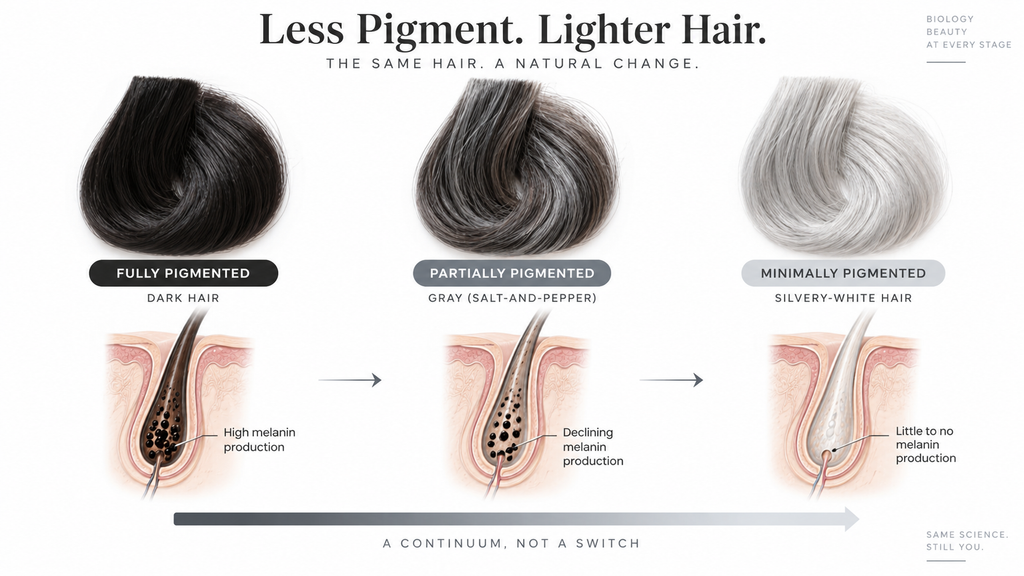
If you are comparing gray hair vs silver hair, what is most important to realise is that they aren’t two entirely distinct biological types of hair; in both cases there is a reduction or complete lack of melanin, the pigment which gives natural hair its colour, although the way light is reflected by the pigmented and unpigmented hairs can make the hair as a whole look gray, silver or white.
The appearance of grey is generally caused by darker pigmented hairs mixing with hairs that have little or no pigment, while silver usually refers to hair which appears lighter, cooler, brighter and more reflective, even though silver can also be produced on purpose by bleaching and toning rather than through natural graying.
Gray Hair vs Silver Hair at a Glance
| Feature | Gray Hair | Silver Hair |
|---|---|---|
| Basic appearance | Gray, salt-and-pepper, charcoal, or mixed | Bright, cool, luminous, or silvery-white |
| Natural pigment | Usually a visible mixture of pigmented and unpigmented hairs | Often dominated by very lightly pigmented or unpigmented hairs |
| Shine | Can appear soft, muted, or reflective | Often appears brighter because pale strands reflect more light |
| Uniformity | Frequently mixed and uneven | May look more uniform when much of the hair has lost pigment |
| Can occur naturally? | Yes | Yes |
| Can be created artificially? | Yes | Yes, commonly with lightener and toner |
| Maintenance | Natural gray can be relatively low-maintenance | Dyed silver usually requires considerably more upkeep |
| Yellowing risk | Possible | Especially noticeable on very pale silver or white hair |
The terms used are mainly just cosmetic rather than medical in nature; people may call naturally unpigmented hair gray, silver, platinum, or white depending on the quantity of darker hair still present, the lighting, the texture, and personal preference.
What Actually Makes Hair Turn Gray?
Your natural hair color comes largely from melanin produced by melanocytes associated with the hair follicle. As pigment production declines, newly produced hair contains less color, and follicles that no longer supply visible pigment produce hairs that look pale or white. MedlinePlus explanation of hair color and melanin
Research continues to refine exactly how this process happens. Studies implicate declining melanocyte activity, changes involving melanocyte stem cells, oxidative stress, cellular ageing, and other mechanisms rather than a single simple “pigment switch.”
That distinction matters because an individual hair that looks white may contain extremely little pigment, while the entire head can still look gray because that white hair is surrounded by darker strands. In other words, what you perceive as gray is often a visual blend rather than every individual strand literally becoming a uniform gray color.
Does Hair Turn Gray First and Then Silver?
Not necessarily. There is no universal biological sequence in which every strand goes from colored to gray, then silver, and finally white.
A common visual progression is:
- A few unpigmented hairs appear among darker hair.
- The mixture produces a salt-and-pepper or gray appearance.
- More follicles stop producing visible pigment.
- The overall head of hair begins looking lighter.
- With enough pale strands, the hair may be described as silver or white.
The exact appearance varies considerably from person to person because genetics strongly affects when graying begins and how extensively it develops.
What Is Silver Hair?
Silver hair is best understood as an appearance rather than a scientifically separate category of hair pigment. Naturally occurring silver hair generally contains a large proportion of pale or unpigmented strands that reflect surrounding light, giving the hair a brighter, cooler appearance.
The word “silver” is also widely used in professional hair coloring. A stylist may lighten naturally pigmented hair substantially and then use cool-toned color or toner to create an icy silver effect, so two people with nearly identical-looking silver hair may have reached that appearance in completely different ways.
Natural Silver Hair vs Dyed Silver Hair
| Natural Silver Hair | Dyed Silver Hair |
|---|---|
| Develops as pigment production decreases | Created cosmetically |
| Roots normally grow in the same natural pattern | Darker natural roots eventually become visible |
| Does not require bleaching to exist | Often requires substantial lightening |
| Color varies naturally from strand to strand | Can be deliberately made more uniform |
| Main concern is maintaining condition and brightness | Requires both damage control and color maintenance |
Artificial silver can be demanding, especially on naturally dark hair. The American Academy of Dermatology notes that lightening hair substantially requires stronger chemical processing and can increase dryness and brittleness, so repeated bleaching should be approached carefully. Dermatologists’ hair-colouring and lightening guidance

Gray Hair vs Silver Hair vs White Hair
The difference between silver hair vs white hair can be even less precise than the distinction between silver and gray. White hair usually describes strands in which visible pigment is largely absent, while silver describes how very pale hair looks when its surface, surrounding strands, and lighting create a cool reflective appearance.
Researchers examining human follicles have found melanocytes in gray follicles but have reported a greater loss of melanocytes in white hair follicles. That evidence supports thinking about graying as a spectrum of pigment loss rather than three rigid color categories.
A simple way to understand gray vs white hair is this:
- Gray-looking hair: commonly a mixture of pigmented and unpigmented hairs.
- White hair: little or no visible pigment in the strand.
- Silver-looking hair: very pale hair whose tone and reflection give it a cooler, luminous appearance.
Therefore, white hair vs gray hair is primarily a question of pigment and overall visual mixture, while the word “silver” often describes appearance and tone.
Why Does Some Natural Gray Hair Look Silver?
Light behaves differently on very pale strands. As more and more white or nearly pigment-free hairs grow beside one another, the overall effect may become bright rather than charcoal-gray.
Hair texture, lighting, remaining natural color, environmental buildup, styling products, and yellow undertones can all change what you see in the mirror. That is why the same person’s hair may look white outdoors, silver under cool studio light, and gray in a dim room.
Smooth, well-conditioned hair can also appear shinier because its surface reflects light more evenly. This means “silver” should not automatically be interpreted as evidence that a person possesses a fundamentally different biological hair type.

Natural Silver Hair at a Young Age: Is It Possible?
Yes. Natural silver hair at a young age is possible because there is considerable individual variation in when pigment loss begins.
Genetics is a major influence, and the age considered “early” cannot be interpreted identically for every person or population. Medical literature also associates premature graying with certain nutritional deficiencies, autoimmune conditions, and other health factors, although finding gray hair early does not automatically mean that something is medically wrong.
A few silver or gray hairs in an otherwise healthy young adult may simply reflect inherited timing. However, rapid or unexpectedly extensive pigment changes, especially when accompanied by other symptoms or sharply localised white patches, are reasonable reasons to discuss the change with a dermatologist rather than assuming that supplements or hair products will fix it.
Can Stress Really Cause Gray Hair?
Evidence suggests that stress can influence hair pigmentation, but the story is more complicated than the familiar idea that one frightening event instantly turns an entire head of hair white. NIH-supported animal research found that stress-related sympathetic nervous system activity could deplete melanocyte stem cells involved in regenerating pigment. NIH research on stress and gray hair
Human research has also documented individual hairs that changed pigmentation in association with periods of psychological stress and, in some cases, later regained pigmentation. The researchers emphasised individual follicles and limited reversibility rather than demonstrating a reliable treatment capable of restoring an entire head of age-related gray hair.
Can Grey Hair Turn Black Again?
Occasionally, individual gray hairs can regain pigmentation, so an absolute “never” would be too strong. Documented human research has observed repigmentation in individual hairs, and the American Academy of Dermatology notes that gray hair may sometimes grow in with color again under particular circumstances, such as changes involving stress or treatment of an underlying condition.
However, there is currently no dependable cosmetic routine, shampoo, oil, vitamin, or home remedy proven to reverse ordinary genetically determined age-related graying across the scalp. Large-scale reversal remains an active area of research rather than an established treatment.
This distinction is important when you encounter products promising permanent pigment restoration. Improving shine or staining the strand is not the same as restarting melanin production inside the hair follicle.

Why Gray and Silver Hair Can Become Yellow
Because gray, silver, and white hairs contain little pigment, discolouration can become especially noticeable. Environmental exposure, hair products, mineral buildup, smoking, heat, ultraviolet exposure, and chemical treatments can all affect the appearance of pale hair.
UV exposure is particularly worth considering. Dermatologists note that lighter and gray hair lacks some of melanin’s natural protective effect and may be more susceptible to UV-related dryness, brittleness, and color changes.
Purple or violet-toned hair products are commonly used cosmetically because violet can visually counteract yellow tones. They do not restore melanin or biologically turn gray hair into silver hair, so they are best thought of as toning products rather than treatments for graying.
How to Keep Gray or Silver Hair Looking Healthy
Whether your color is naturally gray, naturally silver, or professionally created, healthy-looking hair depends more on the condition of the fiber than on the label used for its color. A realistic routine should prioritise moisture, reduced damage, manageable buildup, and protection from excessive heat and light.
I would start with these basic habits:
- Use a shampoo that suits your scalp and hair type. Avoid assuming that every person with gray hair needs the same product.
- Condition regularly. Pale strands can make roughness, frizz, and surface damage especially visible.
- Use purple products only when yellow tones are actually present. Overuse may create an unwanted violet cast or leave dry hair feeling less comfortable.
- Limit unnecessary high heat. Heat-damaged hair may become brittle and dull.
- Protect hair from strong sun exposure. A hat offers straightforward physical protection outdoors.
- Be cautious with aggressive lightening. Repeated bleaching can damage the hair fiber even if the final silver color looks attractive.
- Pay attention to your scalp. Burning, itching, redness, or swelling after color products should not simply be ignored.
The American Academy of Dermatology recommends stopping a hair dye if it causes symptoms such as redness, swelling, burning, or itching and seeking professional advice when an allergic reaction is suspected.

Should You Call Your Hair Gray or Silver?
Use whichever description best matches how your hair looks and how you prefer to describe it. There is no medical requirement that a particular percentage of white strands must be reached before someone is “allowed” to call their hair silver.
From a practical hair-care perspective, it is more useful to identify whether your hair is naturally losing pigment, artificially lightened, yellowing, dry, damaged, or changing unexpectedly. Those characteristics affect what the hair needs far more than whether the shade is called gray, grey, silver, or white.
When Is Early Graying Worth Discussing With a Doctor?
Ordinary graying is usually part of normal variation and ageing, but unexpectedly early or unusual changes deserve more attention when other symptoms are present. A dermatologist can assess whether an underlying medical condition may be contributing rather than recommending supplements without knowing whether you are actually deficient. AAD guidance on causes of gray hair
Consider asking a healthcare professional about it when graying is unusually rapid, begins very young, occurs in sharply defined white patches, or appears alongside symptoms such as unexplained fatigue, skin pigment changes, substantial hair loss, or other health concerns. This article is general educational information and is not a diagnosis or substitute for individualised medical care.

FAQs
Is silver hair the same as gray hair?
Not exactly, but the terms overlap. Gray usually describes the visual mixture produced when pigmented and unpigmented hairs grow together, while silver tends to describe a lighter, brighter, cooler appearance dominated by pale strands.
What is the difference between silver hair vs white hair?
White hair generally has little or no visible pigment, while silver describes the cool, reflective appearance pale hair can have. A strand that is biologically close to white may therefore look silver because of lighting, surface condition, surrounding hairs, and styling.
Is gray hair actually gray?
Often, not in the way people imagine. The overall gray appearance commonly comes from white or nearly unpigmented hairs mixing with darker pigmented strands, although individual hairs can also show reduced pigmentation.
Can grey hair turn black again naturally?
Individual hairs have occasionally been documented regaining pigment, and certain reversible factors may influence some cases. However, reliable reversal of ordinary age-related or genetically determined graying is not currently available as a standard treatment.
Is natural silver hair at a young age normal?
It can be. Genetics can cause some people to begin graying considerably earlier than others, although very early, rapid, patchy, or otherwise unusual pigment loss may justify discussing possible causes with a dermatologist.
Which looks lighter, gray or silver hair?
Silver usually describes a lighter and more reflective appearance, while gray often contains more visible contrast between darker and unpigmented strands. The effect varies substantially with lighting, hair texture, remaining natural pigment, and styling.
Does silver hair eventually become white?
It can appear increasingly white as the proportion of unpigmented hairs rises, but there is no required silver-to-white stage. “Silver” and “white” frequently describe different visual impressions of very lightly pigmented or unpigmented hair rather than separate biological endpoints.
Conclusion
The gray hair vs silver hair difference is easier to understand once you separate biology from appearance. Gray commonly results from the visual mixture of pigmented and unpigmented strands, while silver usually describes a brighter, cooler, more reflective appearance that may develop naturally or be created through professional coloring.
White hair sits at the lowest-pigment end of the spectrum, but real hair rarely follows neat color categories. Genetics, the amount of pigment remaining, lighting, texture, hair condition, and cosmetic treatments all influence whether someone describes their hair as gray, silver, or white.
Rather than trying to force your hair into a particular label, focus on what it actually needs. Keep naturally gray or silver hair conditioned and protected, approach intensive bleaching carefully, and speak with a dermatologist when unusually early or rapid pigment changes raise concerns.