


I’m a Skincare Beginner. Is Nivea a Good Starting Brand Compared to Garnier?
If you are asking, “I’m a Skincare Beginner. Is Nivea a Good Starting Brand Compared to Garnier? Is Nivea a better starting brand than Garnier? Yes, but not necessarily better than Nivea. If the primary problem is dry skin and hydration, then Nivea may be a good choice. For micellar cleansing, removing makeup, or lighter skin care, Garnier is more versatile.
It’s not just about the logo on the box; it’s about the formula. If you have dry cheeks, a rich Nivea cream might feel good, but it might be too oily for your forehead. Garnier micellar water is fragrance-free, so it won’t strip your skin of the moisturizer it needs while removing makeup.
We will go over the comparison of brands, what products work best for your skin type, and a basic skincare regimen without spending a ton of money on products.
This information is meant to provide general skincare information and is not a diagnosis or treatment plan. When acne doesn’t clear up, eczema does, swelling, painful cracking, or a recurrent rash occurs, consult a board-certified dermatologist.
I’m new to skincare. Nivea Vs Garnier: Which Is Better For Beginners? The Short Answer
For an easy, moisturizing option, and if your skin can handle it, the heavier scent and texture, Nivea is a good brand to start with. If you prefer gentle makeup removal, micellar cleansing, or products focused on a specific cosmetic concern, then Garnier is a great choice to start with.
It doesn’t matter that you continue with the same brand throughout your routine. Actually, a Garnier cleanser and a matching Nivea moisturizer and a third-brand sunscreen may work better than three products, just because they look the same.
| Your priority | Where to look first | What to check before buying |
|---|---|---|
| Rich moisture for dry areas | Nivea | Fragrance, texture, facial suitability, and pore-clogging claims |
| Makeup or sunscreen removal | Garnier | Micellar formula, eye-area directions, and waterproof-makeup compatibility |
| Sensitive or reactive skin | Neither brand automatically wins | “Fragrance-free,” not merely “unscented,” plus a patch test |
| Oily or acne-prone skin | Product-dependent | Oil-free and non-comedogenic labeling |
| Dullness or uneven-looking tone | Garnier has more targeted options | Active ingredients, irritation risk, and daily sunscreen use |
| A minimal first routine | Either brand or a combination | Gentle cleanser, moisturizer, and broad-spectrum SPF 30 or higher |
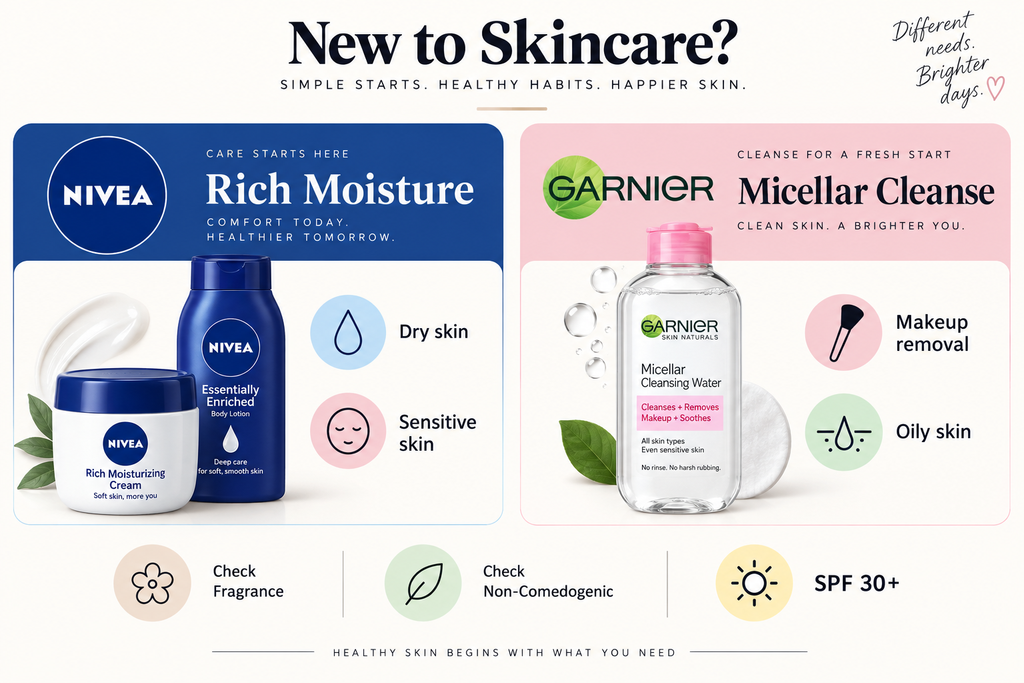
What a Beginner’s Skincare Routine Really Needs
In skincare aisles, you will find toners, masks, serums, scrubs, spot treatments, and more designed to make you purchase them on the spot. It is better for most beginners to learn three basic functions first and then go for the extras.
The American Academy of Dermatology’s basic skincare guidance emphasizes sensible daily care rather than a complicated collection. Here are my suggestions for the basics:
- A mild cleanser: should cleanse away sweat, excess oil, makeup, and everyday dirt without causing your face to feel tight or uncomfortable.
- A good moisturizer: It should make your skin feel comfortable, not greasy for long periods of time, stinging, or causing new congestion.
- Use sunscreen daily: Water-resistant, broad-spectrum, SPF 30 or higher.
A serum can be used or not. Once you are familiar with your basic routine, you can add one product to target acne, dark spots, and/or visible signs of aging.
Nivea and Garnier do different things better
Comparing one whole brand is just masking the most vital ones. Both brands have a huge selection of formulas and products, and within a specific brand, they can have different scents, consistencies, active ingredients, and uses.
What Nivea offers a beginner
Nivea is renowned for its creams, lotions, body moisturizers, lip products, and men’s grooming products. It has the familiar blue-tin cream, which is a multipurpose moisturizer for face, hands and body.
The current official Nivea Creme ingredient list includes glycerin, mineral oil, petrolatum, lanolin alcohol, panthenol, and fragrance. Glycerin attracts water, and mineral oil and petrolatum slow moisture loss, and that is why the product feels so dense and protective.
That combo can help with dry hands, elbows, knees, or parts of the face that can handle rich creams. But because of the scent and heavy texture, I wouldn’t automatically reach for it for every sensitive, oily, acne-prone face.
What Garnier offers a beginner
Garnier’s skin care line is more oriented towards micellar water, makeup remover, skin cleanser, brightener, and ingredient-based products. This means there are more focused choices for those new to the game, but it can also lead to a more complicated shelf.
The original Garnier SkinActive Micellar Cleansing Water is marketed as alcohol-free, oil-free, and fragrance-free. If you’re looking for a quick first cleanse or a makeup remover, then this is a formula to consider. Micellar water is not a moisturizer, it’s not an acne treatment. It clears away, so you may need to use a facial moisturizer and sunscreen afterward.

Nivea vs. Garnier for Different Skin Types
Your skin type is a good starting point, but it is not a permanent label. Weather, hormones, medication, shaving, cleansing habits and skin conditions can all influence how a product feels.
Dry Skin
Nivea Creme may be the more logical first product if your skin feels rough, flaky, or tight and you enjoy a substantial cream. Occlusive ingredients can be especially useful on dry areas of the body, but a fragranced multi-purpose cream is not always the best facial moisturizer for all.
The AAD’s advice for choosing a moisturizer recommends fragrance-free, non-comedogenic options. If Nivea Creme stings, causes itching, or feels excessively greasy, switch to a lighter fragrance-free facial moisturizer instead of assuming that dryness requires the thickest product available.
Oily or combination skin
Garnier may provide more convenient cleansing options for oily or combination skin, particularly if you wear makeup. Its classic micellar water has a water-light texture, but a pleasant texture doesn’t mean every Garnier product suits acne.
The AAD advises people with oily skin to look for products labeled oil-free and non-comedogenic. I would check those terms on each cleanser, moisturizer, sunscreen, and makeup product rather than awarding either brand a blanket victory.
Sensitive/Reactive skin
Neither brand takes the sensitive-skin category overall. Nivea Creme is fragranced. Garnier has a range of products from simple micellar formulas to more specific products that need to be judged on their own.
A fragrance-free Garnier micellar water might be easier to try than a fragranced cream, but it only covers the cleansing step. You will still need to find a compatible fragrance-free moisturizer, which could be from Nivea, Garnier, Cetaphil or others.
Skin prone to acne
Don’t think of a regular cosmetic cleanser or moisturizer as an acne medication. Gentle skincare can help with acne treatment, but to clear acne you may need an active ingredient proven to work, such as salicylic acid, benzoyl peroxide, adapalene, or a prescription treatment.
The AAD notes that salicylic acid can help open clogged pores, but active ingredients may also dry or irritate your skin. Start with one treatment at a time, follow its directions, and stop experimenting if your acne becomes painful, widespread, or starts to scar.
Normal skin
Normal skin still needs thoughtful product selection. If you are not dealing with persistent dryness, oiliness, or sensitivity, choose products that suit you in terms of texture, fragrance tolerance, daily habits, and how often you will use them.
On days you wear makeup, you could use Garnier micellar water and a little bit of Nivea cream on dry areas. There’s nothing in the skincare rulebook that says your cleanser and moisturizer have to be from the same brand.

A Simple Routine Using Nivea, Garnier, or Both
I would build a routine by assigning each product a job. This will prevent double purchases and will make it easier to identify the culprit if you get irritated.
| Time | Step | Beginner-friendly approach |
|---|---|---|
| Morning | Cleanse | Rinse with water or use a gentle cleanser if needed |
| Morning | Moisturize | Apply a light or rich formula according to your skin |
| Morning | Protect | Finish with broad-spectrum, water-resistant SPF 30+ |
| Evening | Remove makeup and sunscreen | Use a compatible micellar water or cleansing balm |
| Evening | Cleanse | Follow with a gentle rinse-off cleanser when needed |
| Evening | Moisturize | Apply enough to relieve tightness without overloading the skin |
Example for dry skin
In the morning, cleanse with a gentle hydrating cleanser or rinse with lukewarm water. Follow with a soothing moisturizer and sunscreen. At night, cleanse gently and apply Nivea Creme only if your face can tolerate its fragrance and rich texture.
If the cream is too heavy for your whole face, use it only on dry patches, hands, or body. A product isn’t necessarily useful if it isn’t appropriate everywhere.
For oily skin and skin that wears make-up
Morning: Use a light cleanser, and finish with a non-comedogenic moisturizer and sunscreen. You can use Garnier micellar water at night to remove make-up before your normal gentle cleanser.
Don’t rub with cotton pads multiple times for a “squeaky-clean” feeling. Over-scrubbing and harsh cleansing irritate skin without addressing the root cause of oil production.
Sunscreen is not optional.
Neither a moisturizing cream nor micellar water replaces sunscreen. The AAD recommends a product with broad-spectrum protection, water resistance, and SPF 30 or higher.
Apply sunscreen before going outdoors as the final step in your morning skin care routine. When outdoors, follow the reapplication instructions on the sunscreen product. Select a texture that you can commit to, even if it means buying a sunscreen from a different brand.

How to Test a Product Without Disrupting Your Routine
Launch one new product at a time. If you start using a cleanser, cream, serum, and exfoliant the same evening and your skin reacts with burning or bumps, you won’t know which product caused the reaction.
The AAD recommends testing a skincare product on a small area twice daily for seven to ten days. Use the product for the same amount of time as you normally would, including rinsing away a cleanser as directed.
Stop using a product if you notice redness, swelling, itching or any discomfort that does not go away. See a doctor for serious or ongoing reactions, especially if they involve the eyes, blistering, or facial swelling.

Common Beginner Mistakes to Avoid
Buying by brand instead of formula
A brand may have one product that’s perfect for you and another that’s not. Check the directions, ingredient list, fragrance status, and relevant claims on the actual package you are considering.
Using Nivea Body Cream as a Face Moisturizer: Automatic
Multipurpose use on the label means you can use the product in multiple areas. But that doesn’t mean the texture will feel good on every oily, sensitive or acne-prone face.
Micellar water as a stand-alone routine
Micellar water takes off makeup and surface debris, but it doesn’t do everything your skin needs. Apply with a good moisturizer and use sunscreen during the day.
Overloading on active ingredients
Vitamin C, exfoliating acids, retinoids, and acne treatments can help if you choose them for a specific concern. If you start several at the same time, you increase the risk of irritation and make troubleshooting difficult.
Assuming ‘dermatologically tested’ is a universal recommendation.
A testing statement is not equivalent to a personal recommendation from your dermatologist. The FDA explains that cosmetic labeling claims are not individually preapproved, although they must still be truthful and not misleading.
Treating dark spots without skipping sunscreen
Brightening products do not protect your skin from new ultraviolet exposure.
“Before you start buying serums, the first and most important step is to make sunscreen the foundation of a dark-spot routine.
Nivea vs. Garnier: Pros and Limitations
| Brand | Useful qualities for beginners | Limitations to consider |
|---|---|---|
| Nivea | Straightforward moisture-focused products; rich options for dry areas; multipurpose face, hand, and body cream | Some popular formulas contain fragrance; rich textures may not suit every face; fewer obvious choices for makeup removal.l |
| Garnier | Well-known micellar cleansing options; fragrance-free choices within the micellar range; more targeted cleansing and brightening variations | A larger selection can encourage unnecessary purchases; targeted ingredients may irritate some users; the cleanser still needs supporting moisturizer and sunscreen. |
| Either brand | Accessible way to begin with one basic product | No brand can guarantee compatibility with your skin or replace professional acne and eczema care |
The most useful comparison is not “Which company is better?” It is “Which exact product performs the missing step in my routine with the fewest unnecessary risks?”
FAQs
Garnier or Nivea? Which is better?
If you prefer more moisturization, particularly on dry skin on your body, or if you can handle heavier creams, Nivea might be a better choice. Garnier might be better suited to micellar cleansing, makeup removal, and lighter/more targeted products, but it all depends on the makeup and skin type.
Are dermatologists recommending Nivea?
A dermatologist may suggest using a certain type of Nivea product if it is suitable for the patient, but dermatologists do not recommend all Nivea products. The claim “dermatologically tested” is a marketing statement of the manufacturer and does not indicate that it is suitable for all skin types, including sensitive, oily, acne-prone, or eczema-prone skin.
Nivea vs Dove – which is better?
There is no brand that is superior in all of the categories. Dove might be a better comparison for cleansing bars and body washes, while Nivea is a natural choice for rich creams and body lotions. However, base your facial product purchases on scent, consistency, and a non-comedogenic guarantee.
As posted above, Garnier vs Cetaphil: which one is better?
Garnier is better known for its micellar water, make-up remover, and some cosmetics, while Cetaphil is more popular for its gentle cleansers and moisturizers. Sensitive skin? Not all products from either brand are guaranteed to be gentle; compare individual fragrance-free formulas.
Can I Mix Nivea And Garnier?
Yes, you can mix and match Nivea and Garnier products in your routine, as long as the formulas work for your skin. So, for example, you might use Garnier micellar water to remove your makeup and a Nivea moisturizer on the dry areas, and then a separate SPF 30+ sunscreen in the morning.
Conclusion: Begin With Your Skin, Not Brand Loyalty
So, I’m a Skincare Newb. Is Nivea a Good Starting Brand as Compared to Garnier?” has a conditional answer. Nivea is a reasonable place to start for basic hydration, while Garnier may be the more helpful first stop for micellar cleansing and makeup removal.
I recommend starting with a gentle cleanser, a good moisturizer, and broad-spectrum SPF 30 or higher. Always patch test; always give your skin time to respond before adding anything else. Check the current label of every product.
Pick one missing step in your routine today, instead of buying a full branded set. Usually, three compatible products used regularly will do your skin more good than a shelf full of poorly matched products.
Also Read: I Have Sensitive Skin. How Gentle Are NIVEA’s Creams Compared to Aveeno?
I Am a GenZ Woman. How Does CeraVe Compare to The Ordinary in Terms of Skincare Effectiveness?