


How Long Does Straightened Hair Last?
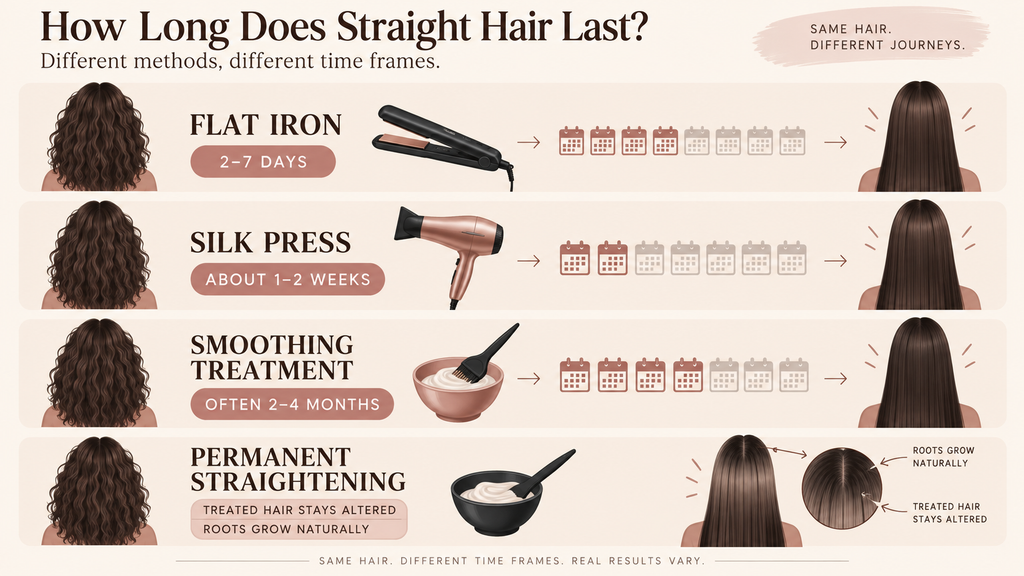
If you are wondering how long does straightened hair last, a temporary flat-iron style usually remains smooth for a few days to about a week. A carefully maintained silk press on natural or coily hair may last one to two weeks, but water, sweat, humidity, oil, and washing can make any heat-straightened style revert sooner.
The timeline for chemical services is different since a smoothing treatment may last for several weeks or months, whereas a relaxer or permanent straightening treatment alters the hair until it has grown out or is cut off. This article explains the difference, provides realistic estimates according to hair type, and shows you how to maintain a straight style without having to repeatedly use damaging heat.
Quick answer: Hair that has been flat-ironed usually remains straight for a period of two to seven days. Some silk presses can last one to two weeks provided that the scalp is clean and the hair is kept dry. However, these are only approximate timeframes and not guarantees, since factors such as your washing routine, the weather, exercise, the condition of your hair, the products you use, and your technique may be more important than your curl pattern alone.
How Long Does Straightened Hair Last by Method?
The word “straightened” can describe several very different services. Before judging how long your result should last, identify whether the process temporarily styled the hair or chemically changed its structure.
| Straightening method | Practical duration | What ends or changes the result |
|---|---|---|
| Flat iron at home | 2–7 days | Washing, humidity, sweat, rain, or natural oil buildup |
| Salon blowout | 3–7 days | Washing, moisture, exercise, and loss of volume |
| Silk press on natural hair | About 1–2 weeks | Washing or enough moisture to trigger reversion |
| Keratin or smoothing service | Often 2–4 months | Gradual fading, washing, and new growth; the formula matters |
| Chemical relaxer | Treated lengths remain altered | Natural texture appears at the roots as hair grows |
| Japanese straightening or thermal reconditioning | Treated lengths remain straight | New growth retains its original texture |
The temporary estimates overlap because there is no universal timer built into hair. For example, a person with loose waves who exercises daily may see bends at the roots sooner than someone with tight coils who avoids moisture and wraps a silk press every night.
Why Heat-Straightened Hair Goes Back to Its Natural Texture
A flat iron shapes the hair temporarily by using both heat and pressure, and it does not remove your natural wave, curl, or coil pattern permanently. The hair may lose the temporary shape it has been given and start to go back to its original state when it absorbs moisture from washing, steam, sweat, rain, or humid air.
That is why the first sign of reversion often appears around the hairline, nape, or roots. Those areas are close to the scalp, exposed to perspiration, and more likely to encounter skincare products or water. Reversion is not automatically a styling failure; it is the expected behavior of temporarily straightened textured hair.
Does straightened hair go back to normal?
Hair which has only been straightened using heat should return to its normal pattern when it has got wet and been washed. Although the first wash may not produce a clearly defined curl pattern if the hair has buildup, is heavy, or requires conditioning, the natural texture should not stay permanently straight as a result of a single careful styling session.
If after several washes the sections remain limp or straight, or if you notice any roughness, snapping, split ends, or a burnt smell, then heat damage may have occurred. You should stop using heat and think about getting advice from a licensed stylist or a board-certified dermatologist, particularly if you also observe thinning or symptoms on the scalp.

How Long Straightened Hair Lasts on Different Hair Types
The type of hair does influence how fast a style may display waves, curls, or puffiness at the roots, but it does not alone determine the outcome. The timeline is affected by porosity, the thickness of the strands, any existing damage, the oil from the scalp, the quality of the styling, the weather, and exposure to moisture.
Wavy hair
Wavy hair that has been straightened usually appears smooth for about three to seven days, typically until the next washing. The loose waves might come back a bit earlier at the sides of the ears, the nape, or the ends if the weather is damp, but the change in this case is often only slight rather than a full return.
Fine wavy hair may become oily or flat before it becomes visibly wavy again. In that case, the practical end of the style is determined by scalp comfort and cleanliness, not by whether every strand is still straight.
Curly hair
Curly hair that has been straightened usually remains straight for about two to seven days; although a blowout or flat-ironing done in a salon may sometimes keep the straightness for a longer period, steam, sweat, and humid conditions can cause the texture to return at the roots within a few hours.
Curly hair can also be naturally dry and prone to breakage, so extending the style should never mean ignoring an itchy scalp or repeatedly ironing fuzzy sections. The American Academy of Dermatology’s heat-styling guidance recommends the lowest heat setting, brief contact, and less-frequent use of hot tools.
Black natural hair and 4C hair
“Black hair” includes many densities, strand sizes, curl patterns, and styling routines, so there is no single duration based on race. On natural Black hair, a flat-ironed style may last several days, while a well-executed silk press on 4C hair may remain wearable for one to two weeks if it is wrapped nightly and protected from moisture.
Tighter coils do not automatically require the highest temperature. The goal is the lowest setting that produces a smooth result with minimal passes. Dermatologists’ everyday care advice for Black hair recommends a heat protectant, a temperature-controlled ceramic tool, and thermal straightening no more than about once a week.

What Makes Straightened Hair Last Longer or Revert Faster?
The best estimate comes from your routine, not a curl chart. Think about the conditions your hair will face over the next week and whether keeping it straight is compatible with your scalp and lifestyle.
Factors that can shorten the style
- Humid or rainy weather can encourage frizz and reversion.
- Sweat from workouts, hot sleep, or hats can affect the roots and hairline.
- Shower steam and water droplets can reach uncovered hair.
- Heavy water-based products can reintroduce enough moisture to disturb the style.
- Oily roots, dandruff, itching, or product buildup may make washing necessary.
- Poor preparation, uneven drying, and large flat-iron sections can produce a result that changes quickly.
Factors that can extend the style
- Starting with clean, conditioned hair and a clean scalp gives the style a better foundation.
- Drying the hair completely before using a conventional flat iron reduces the risk associated with pressing damp strands.
- Using small, even sections can create a smooth result with fewer passes.
- Wrapping or securing the hair loosely at night reduces friction and dents.
- Protecting the hair from rain, shower steam, and perspiration helps delay reversion.
One detail I would not overlook is scalp health. Dry shampoo can absorb oil and refresh a style, but it does not wash the scalp. The AAD’s dry-shampoo advice says regular shampoo and water are still needed and recommends washing after one or two dry-shampoo applications.
How to Keep Hair Straightened Overnight
The goal at bedtime is to reduce moisture, rubbing, tangles, and sharp bends. You do not need to reapply heat each morning if you protect the shape before sleeping.
- Make sure your hair is dry and cool. Do not wrap damp or sweaty hair, because trapped moisture can create frizz and scalp discomfort.
- Detangle gently. Use your fingers or a wide-tooth comb, working from the ends upward without pulling.
- Wrap or loosely secure the hair. For a classic wrap, brush sections around the head and pin them flat without tight tension. Long hair can also be gathered into a loose low wrap or a few large pin curls if you want body at the ends.
- Cover it with silk or satin. Use a scarf or bonnet that stays in place without squeezing the hairline. A silk or satin pillowcase provides backup protection if the covering slips.
- Keep the room comfortable. If you tend to sweat at night, lighter bedding and better airflow may do more for the roots than adding another styling product.
Don’t use tight elastics or small buns since they can cause dents. Although a little bit of lightweight serum on the dry ends might help to reduce friction, applying too much oil, cream, and spray can make the hairstyle seem heavy and lead to more product build-up.

How to Make a Flat-Iron Style Last Without More Heat
Start with a realistic target. If your hair usually reverts after four days of workouts, trying to force a two-week style may lead to repeated passes, excess buildup, or neglecting your scalp.
Before straightening
- Shampoo the scalp and remove heavy buildup.
- Condition the lengths and detangle gently.
- Apply a heat protectant according to its label. A protectant may reduce damage, but it does not make unlimited heat safe.
- Dry the hair fully using the gentlest effective method.
- Make sure the flat-iron plates are clean and glide without snagging.
During straightening
Work in manageable sections and use the lowest effective temperature. Slow, controlled technique should aim for minimal passes rather than repeatedly clamping the same strand.
You should not use a regular flat iron on wet hair unless the appliance is clearly designed and marked for use from wet to dry. In that case, it is necessary to adhere to the manufacturer’s instructions since the safety depends on the presence of water, the amount of heat, and the design of the tool.
After straightening
Let the hair cool down before tying it or wrapping it. When having a shower, use a secure shower cap and make sure the bathroom is well ventilated so that the steam doesn’t gather around the hairline.
Following exercise, press the roots rather than rub them and allow the scalp to dry out before wrapping. If the roots are damp, odorous, extremely oily, or itchy, then wash the hair rather than attempting to keep the style at the cost of scalp comfort.
When You Should Wash Straightened Hair
Wash when your scalp needs cleansing, even if the lengths could remain straight for another day. Oil, dead skin, sweat, styling residue, and dry shampoo can accumulate, and a straight appearance is not evidence that the scalp is clean.
How often you should wash your hair will depend on the texture of your hair, the amount of oil it produces, your level of activity, and the state of your scalp; this could be every day, every few days, once a week, or even more infrequently. The AAD recommends that many people with Black hair wash their hair once a week or every other week in order to reduce drying buildup, but in some cases dandruff, heavy exercise, medical conditions, or personal comfort can make it necessary to follow a different washing schedule.
Wash sooner if you notice:
- Persistent itching, burning, tenderness, or odor
- Visible flakes or heavy residue
- Sweaty roots that do not dry comfortably
- Hair that feels stiff, coated, or unusually tangled
- A product reaction or scalp rash
Heat Damage: When Straight Hair Lasts Too Long
The fact that straight hair stays straight doesn’t mean that it will be a more lasting success. Repeated exposure to high heat can damage the cuticle and weaken the hair fibre. Research into drying hair has shown that surface damage increases as the temperature goes up, which supports the simple rule that more heat is not automatically better.
The AAD recommends using hot tools once a week or less, allowing hair to air-dry when possible, and choosing the lowest heat setting. If you need multiple touch-ups every day, switch to a low-manipulation style and give the hair a break instead of continuing to press it.
Things that should be noted are curls that still stay rather loose following a number of washes, small broken bits, split ends, a rough texture, a loss of elasticity, or thinning. Although a stylist is able to evaluate cosmetic damage, a board-certified dermatologist is more appropriate when it comes to scalp pain, persistent shedding, bald spots, or unexpected changes in texture.

Temporary Heat Styling vs. Chemical Straightening
If your result came from a keratin treatment, relaxer, or thermal reconditioning service, the temporary estimates in this article do not apply. These services involve formulas and processes that can smooth the hair for months or permanently alter treated sections, although new growth still comes in with its natural texture.
Ask the salon for the exact service name, aftercare instructions, ingredient information, and expected touch-up schedule. Do not apply a relaxer over previously relaxed lengths. The AAD advises spacing relaxer touch-ups about two to three months apart and limiting application to new growth.
Some smoothing products can release formaldehyde gas when heated. Review the FDA’s guidance on formaldehyde in hair-smoothing products and ask to see the product label or safety data sheet before agreeing to a service. OSHA has also reported that some salon smoothing products may release formaldehyde above workplace exposure limits, including some products marketed without clear formaldehyde warnings.
Common Mistakes That Shorten the Style or Harm Hair
The first common mistake is chasing perfectly straight roots every morning. Repeated touch-ups place heat on the same fragile areas, especially the hairline and nape, for only a small cosmetic gain.
Another mistake is using more product every time frizz appears. Water-rich creams may encourage reversion, while layers of oil and dry shampoo can create buildup without cleaning the scalp. Use only what the style needs, and wash when comfort or hygiene calls for it.
Finally, do not choose heat based only on a viral temperature chart. Tools vary in accuracy, and hair with bleach, color, weathering, or breakage may tolerate less heat than untouched hair of the same curl pattern. Start low, follow product and tool instructions, and stop if the hair smokes, smells scorched, snags, or becomes brittle.
FAQs
Does straightened hair go back to normal?
After washing or having been exposed to a sufficient amount of moisture, hair that has been temporarily straightened should tend to go back to its natural texture; if certain sections are still straight, limp, or rough following a number of washes, then you should cease using heat since the hair could be damaged.
How long does straightened hair last on Black hair?
Straightened Black hair may last several days, while a protected silk press can sometimes last one to two weeks. Hair texture, sweat, humidity, scalp condition, wash routine, and nighttime care are more useful predictors than race alone.
How long does a flat iron last on natural hair?
A flat iron style on natural hair usually stays for a few days to about a week, and in some cases styles that are well looked after can last as long as two weeks; the style ends when the hair is washed or when it has absorbed sufficient moisture to return to its original state, so do not keep applying heat just to achieve a certain number of days.
How long does straightened hair last on curly or wavy hair?
A straight hairstyle on wavy hair usually stays in place for three to seven days, while on curly hair a reasonable estimate would be two to seven days; however, the weather, activity level, washing and the quality of styling can cause this time frame to be shorter or longer.
How long does straightened hair last on 4C hair?
A 4C style that has been flat-ironed can last for several days, and a silk press done by a professional can be worn for one to two weeks if it is carefully wrapped at night and exposure to moisture is avoided. Since 4C hair is fragile, its longevity should be achieved through proper preparation and protection rather than by using a lot of heat or requiring daily touch-ups.
Conclusion
The honest answer to how long does straightened hair last is usually a few days to one week for a flat-iron style and up to about two weeks for some protected silk presses. Moisture exposure, exercise, scalp oil, hair condition, and your wash routine can shift that estimate in either direction.
I suggest that you keep a record of everything that takes place following your next straightening treatment be sure to note the weather conditions, the products you use, your workout schedule, the method you adopt at night, and the day on which the roots start to revert. Plan your future hairstyles on the basis of this information and decide to go with healthy hair and a comfortable scalp rather than trying to get one more day out of it. For more practical advice on beauty and self-care, visit Story Prior as you develop a routine that suits your real hair rather than an idealised timetable.